
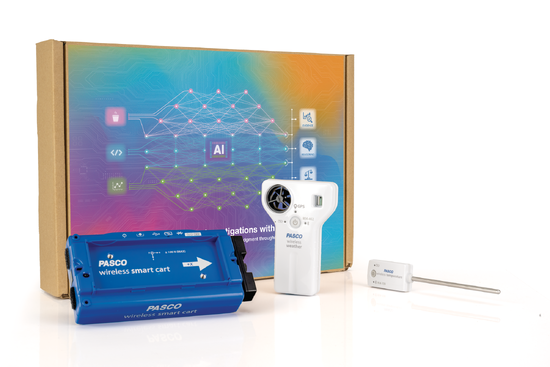
AI Sensemaking Investigations Kit for Science Education - ST-1149
Hands-on equipment provides the evidence. Investigations provide the structure. AI supports the conversation. Students do the thinking. Together, they create a powerful learning experience grounded in real data, inquiry, and scientific discovery.
Product Summary
The AI Sensemaking Investigations Kit helps middle and high school science and STEM educators introduce AI through hands-on, evidence-first investigations. Students collect and analyze real data before using a school-approved Large Language Model (LLM) to challenge and extend their thinking.
The kit includes PASCO’s Smart Cart, Wireless Temperature Sensor, and Wireless Weather Sensor with GPS. Students use Sparkvue software to collect and analyze real-time data, investigate relationships between variables, and develop evidence-based explanations.
Seven Sensemaking Investigations with AI
- Using AI Wisely
- Designing a Better Insulating Cup
- Building a Better Hand Warmer
- Evaporative Cooling
- Crash Cushion Barrier Design
- Heat Patterns Around Your School Yard
- Speedometers and Simple Motion
Each investigation includes a Student Procedure, Student Answer Sheet, and Teacher’s Guide.
These inquiry-driven investigations augment existing Science and STEM courses with a structured approach to using AI in science education. Students begin with a phenomenon, develop hypotheses, conduct hands-on investigations, analyze their data, and form an initial explanation. They record their reasoning before using AI, making the development of their scientific thinking visible.
Only then do students use AI to challenge and extend their thinking, explore alternative explanations, and strengthen their conclusions. Students compare AI responses with their collected data, scientific principles, and teacher-approved sources. They document what they accept, revise, or reject—and explain how the evidence supports their decisions.
Teacher and student materials establish clear boundaries for appropriate AI use, including evidence checking, attribution, privacy, and student ownership. Students practice recognizing AI’s strengths and limitations, treating its outputs as proposals rather than facts, and understanding when AI supports learning and when it should be set aside.
The goal is not to use AI for faster answers. It is to help students ask better questions, evaluate information against real evidence, and retain ownership of their scientific reasoning.
Large Language Model Required
Access to a large language model (LLM) is required for the AI-supported portions of the investigations. An LLM, account, and any associated subscription are not included with the kit. Educators should select a school-approved LLM and follow applicable school or district requirements for student access, privacy, and AI use.